


Risk Warning: CFDs are complex instruments and come with a high risk of losing money rapidly due to leverage. 76% of retail investor accounts lose money when trading CFDs with this provider. You should consider whether you understand how CFDs work and whether you can afford to take the high risk of losing your money.
Plus500↗︎ is a CFD broker listed on the London Stock Exchange (LSE: PLUS), regulated in the UK by the FCA and across a string of other jurisdictions through separate local entities.
It’s built around a single proprietary platform rather than MetaTrader or third-party software, which shapes almost everything about how it feels to trade there, for better and worse depending on what you’re looking for.
What you can actually trade
The core offering is CFDs (Contracts for Difference), spanning shares, indices, forex, commodities and cryptocurrencies. UK retail clients are the exception on that last point: crypto CFDs aren’t available here at all, a restriction that comes from the FCA rather than from Plus500 itself, so it applies to every UK broker offering retail crypto derivatives, not just this one. Elsewhere, clients can access CFDs on Bitcoin, Ethereum and other major tokens.
What are CFDs and How Does CFD Trading Work? – CFDs are derivatives whose value is based on an underlying asset, enabling traders to speculate, hedge, or gain market exposure.
Beyond CFDs, Plus500 Invest gives access to real share dealing rather than derivatives, covering over 2,700 instruments, though it isn’t available to UK clients and is limited to select markets elsewhere. Plus500 US runs a separate futures offering for US residents only, which allows trading E-mini and micro contracts.
Options are not available for direct trading, although Plus500 offers CFDs based on options-related instruments, allowing traders to speculate on price movements without owning the underlying options contracts.
The broker also provides access to ETF CFDs, Futures Contracts (for US traders only), bond CFDs, extending its CFD range across several asset classes.
Platforms and charting
WebTrader is the main platform, and it runs in the browser without a download. It has continued to improve, now offering 114 indicators, over 20 drawing tools and 13 chart types, alongside pre-defined and customisable watchlists, an economic calendar, and instrument data pulled in from Dow Jones and Yahoo Finance.
Charts can be detached into separate windows, and the platform supports up to 25 charts on screen at once if you want to lay out a proper multi-instrument view. Indicators aren’t automatically saved against a symbol, but saving a chart as a layout template gets around that.
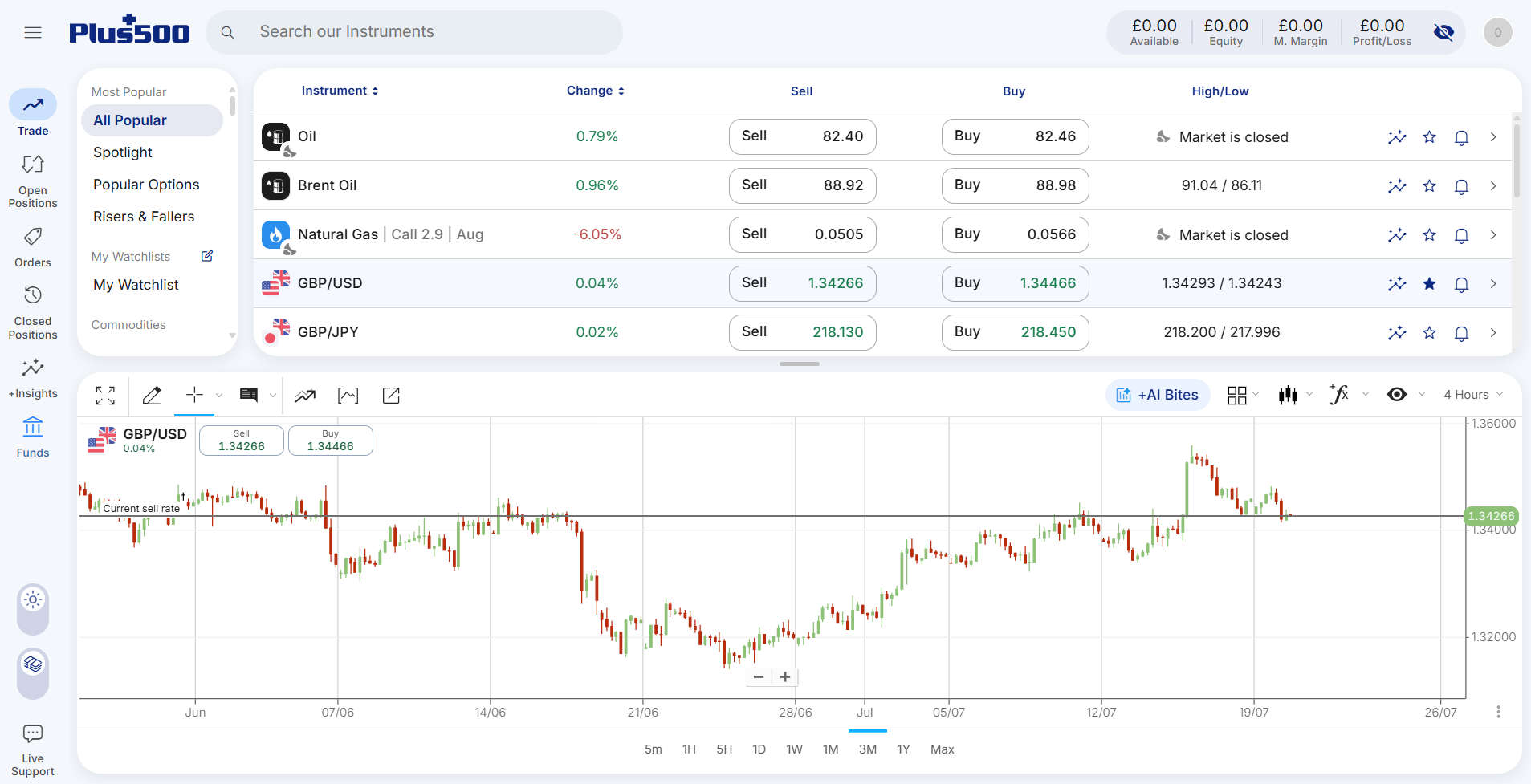
The mobile app mirrors WebTrader closely enough that switching between the two doesn’t feel jarring, though chart settings and indicator layouts don’t carry over between devices, so a setup built on desktop needs redoing on mobile.
The app has picked up genuinely useful additions over the past year: pre-set watchlists, the +Insights sentiment tool showing what other Plus500 traders are buying, selling and losing money on for a given instrument, and a newer +Me dashboard that turns your own trading history into a performance breakdown rather than a flat list of closed positions.
There’s no MetaTrader 4 or 5 support, no algorithmic trading, and no social or copy trading. Anyone building automated strategies or wanting to follow other traders’ positions will need to look elsewhere; this is a manual-trading platform through and through.
Research is present but modest, running to a daily article most weekdays plus video content through Plus500’s Trading Academy, rather than the streaming news feeds offered by research-focused brokers like eToro, IG or Saxo.
7 Publicly Listed Brokers You Can Invest In – An analysis of publicly listed brokers, including companies such as Plus500, exploring how they generate revenue through trading activity, client assets and market participation.
Account types and getting started
Plus500 keeps things simple on the account side: a free demo account with no time limit, and a single live account type rather than a tiered structure with different spreads or perks by account size. The demo comes pre-loaded with virtual funds and mirrors live pricing, which makes it a genuinely useful way to learn the platform and test a strategy before risking anything.
The minimum deposit is £50 when using a debit card, Fast Bank Transfer, Google Pay or Trustly, while standard bank transfers require a minimum deposit of £200. Standard bank transfers can take up to five working days to reach your account.
Identity verification is completed in line with standard KYC requirements, and accounts are typically approved within a few hours to one working day after the required documents have been submitted.
Fees and costs
Plus500 doesn’t charge commission on CFD trades, with its costs built into the spread instead. The platform uses dynamic spreads, meaning they change according to market conditions, liquidity and volatility.
On EUR/USD, spreads average between 0.6 and 0.9 pips during peak trading hours, while spreads on indices such as the S&P 500 start from 0.6 points. Before placing a trade, you can view the current spread under the Rates & Values section of the instrument’s information panel, allowing you to see the live spread before opening a position.
If you keep a position open overnight, an overnight funding charge or credit may be applied depending on the instrument, with the applicable rate shown in the platform before you trade. Plus500 also applies a currency conversion fee of up to 0.7% when you trade instruments priced in a different currency from your account, which is reflected in your profit or loss.
There’s no platform fee, no market data charge, and no fee on deposits or standard withdrawals. An inactivity fee applies after three months without logging in, and a currency conversion charge applies when trading an instrument priced in a currency different to your account base currency. Guaranteed stop orders are available but come with a wider spread attached, which is the trade-off for the extra certainty they offer.
Regulation and where your money sits
Plus500UK Ltd is authorised and regulated by the Financial Conduct Authority (FRN 509909).
Plus500 operates through separate regional entities rather than one global licence: the FCA in the UK, CySEC in Cyprus, ASIC in Australia, MAS in Singapore, and further licences in New Zealand, South Africa, Estonia and the Seychelles, among others.
Its US arm operates under CFTC oversight and NFA membership as a dedicated futures broker.
Client funds held with the FCA and CySEC entities are kept in segregated accounts, separate from the company’s own operating funds. The parent group’s listing on the London Stock Exchange, as a constituent of the FTSE 250, adds a layer of public financial disclosure that most CFD brokers don’t have to provide.
What users report
Plus500 has more than 19,500 reviews on Trustpilot with a score of 4.2, although that figure should be taken with a pinch of salt. Aggregated review platforms rarely provide the full picture and should be viewed as one source of feedback rather than the deciding factor when choosing a broker.
Broker reviews can be influenced by a range of factors, including traders reacting negatively after losses or misunderstandings around how leveraged CFD products work. While reviews can provide useful insight into customer experiences, they should not be the only factor when deciding whether a broker is right for you. Testing the platform yourself through the demo account is often the best way to judge whether it meets your needs.
That said, a recurring theme across Trustpilot, Reddit and independent complaint trackers is worth knowing about regardless of the overall score. A minority of users report withdrawal delays or accounts placed under review with limited explanation.
This doesn’t reflect the licensed entities acting improperly, and most reviewers describe fast, unremarkable withdrawals, but it’s sensible to test the withdrawal process with a smaller amount first before moving larger sums through the platform.
Summary
Plus500 is best suited to traders who already have experience with leveraged products and want access to a broad range of CFD markets through a single, well-regulated platform. The unlimited demo account, simple fee structure with no platform or data charges, and wide instrument coverage make it a practical option for traders who know what they are looking for.
The trade-off is that Plus500 is not designed as a learning platform for beginners. Its research tools are relatively limited, there is no support for algorithmic or copy trading, and spreads can be wider than those offered by specialist forex brokers. For newer traders, the lack of deeper educational tools may be a drawback, while more experienced traders may appreciate the clean platform and broad market access without unnecessary extras.
This review is for informational purposes only and does not constitute financial advice. CFD trading carries a high risk of losing money rapidly due to leverage.
Frequently Asked Questions
Still have questions about Plus500? Here are some quick answers to the most common ones.
What is the minimum deposit required to start trading?
Plus500 features a highly accessible entry point for UK traders, requiring a minimum deposit of just £50 when funding your account via a debit card or Apple Pay/Google Pay. If you prefer to use a traditional bank wire transfer, the minimum requirement increases to £200.
Does Plus500 charge commissions on trades?
No, Plus500 operates on a commission-free model. Instead of upfront trading fees, the broker covers its costs through the “bid-ask spread” (the difference between the buy and sell price of an asset). While these spreads are generally competitive, you should watch out for non-trading costs, such as a £10 monthly inactivity fee if you don’t log into your account for three consecutive months.
Does Plus500 offer a spread betting account?
No, Plus500 does not offer spread betting. They are strictly a CFDs broker in the UK. This is an important distinction because any profits you make are subject to Capital Gains Tax (though you can offset your losses). If you specifically want tax-free spread betting, you will need to look at alternative UK brokers.


